
What 'Factory Direct' Changes in a Custom Jewelry Quote
Factory direct removes a layer between the buyer and the bench. There is no trading office relaying your file, no second queue between the casting and the plating tank, and no separate vendor to ask about a colour run. What it does not remove is time: 25–30 days for a master sample, 3–4 weeks for production, and a 100% inspection between the last step and the carton.
Key takeaways
- Direct manufacturing keeps the mould, the finishing bench and the plating tank in one place, so a fault can be traced to a stage.
- The calendar is unchanged: 48 hours for CAD, 25–30 days for sampling, 3–4 weeks for production.
- Final QC is a 100% inspection of the batch, not a sample of it, and it happens before packing.
- Floors are 50 pcs in sterling silver, 100+ pcs in the stainless line and 100 pcs in the eco-brass line, for each design, so a two-design range doubles those figures.
What direct manufacturing removes from the chain
In a relayed order, your drawing goes to an office, the office places it with a workshop, and the workshop's answer comes back through the same path. Every handover is a queue, and every queue is where a colour question turns into a fortnight.
Under factory direct, the drawing, the mould, the polishing wheel and the plating tank belong to the same operation. That is what makes a question like why the third batch of a bracelet reads warmer than the second answerable at all: there is a bench, a record and a person who ran both batches.
What factory direct does not change
It does not shorten the published windows. CAD is still quoted at under 48 hours because it is screen work. Sampling still takes 25–30 days and covers wax printing in 3D, casting in a precision mould and stone-setting, then gloss polishing and custom plating. Production still runs 3–4 weeks, and the minimums are still set by the base metal rather than by how the order arrives.
Nor does it remove the documents. ISO 9001:2015, an audited BSCI social-compliance programme and REACH restrictions on lead, cadmium and nickel are published by the factory itself, which is the practical difference: they can be requested from the people who operate the process rather than from an intermediary who has to ask.
| Stage | Under factory direct | Through a relaying office |
|---|---|---|
| CAD and renderings | Drawn in house inside 48 hours | Sent out, then returned |
| Master sample | Wax printing, casting, setting, polishing and plating under one roof | Split across vendors with separate queues |
| Bulk production | 3–4 weeks once the sample is approved | Plus the office's own handling time |
| Final QC | 100% inspection before packing | Depends on which vendor ships |
| Marking and packaging | an 18KGP mark on plated work, the S925 hallmark and 316L on stainless marks with branded packaging | Often added by the reseller |
Where inspection sits, and why the position matters
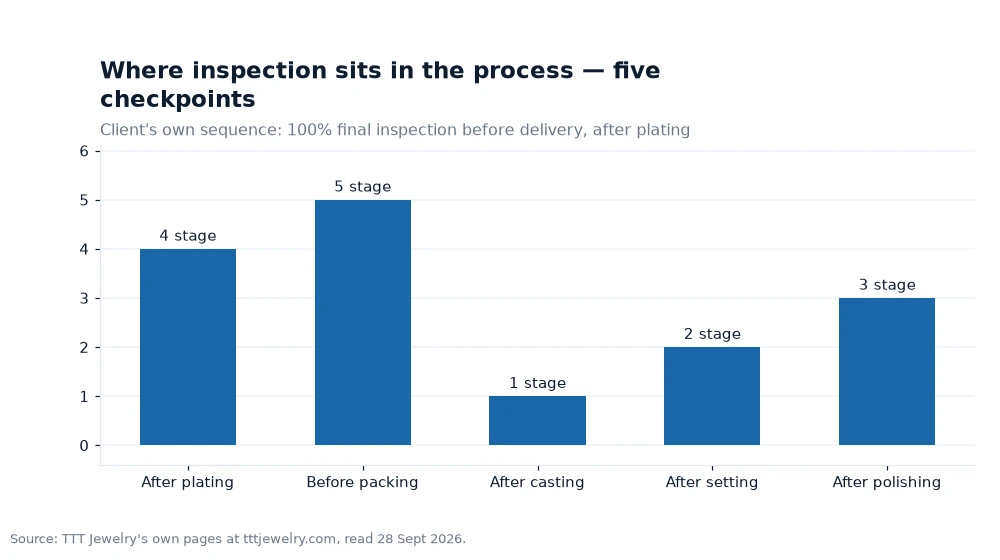
Inspection is easier to reason about as a position in the sequence rather than as a department. The published process names eight steps, and the five metal-working stages that a check can follow are casting, stone setting, polishing, electroplating and packing.
Mapping a checkpoint after each of those five stages is my own reading of the process, not a published inspection schedule. It is still useful, because it shows where a fault can be caught cheaply. A setting fault found before polishing costs a reset; the same fault found in the carton costs a second plating pass on a finished piece.
Worked example: five checkpoints across eight steps
The published sequence has eight steps: 1 concept design and prototype and mould work, through sprue cutting, polishing and surface art, into electroplating, final QC and delivery to the brand. Five bench stages can carry a check before packing, and the published final inspection sits at step seven.
So the checkpoint pattern covers 5 ÷ 8 = 62.5% of the steps if every bench stage is checked once. That figure is arithmetic rather than a promise, and the useful part is the last checkpoint: a 100% inspection at step seven means nothing is boxed before it has been looked at individually.
The question that tests the claim in one email
Ask which of the eight steps happen on the supplier's own floor and which are bought in. A direct manufacturer can answer with a list and a name for each stage. An office that relays work usually answers with a capability brochure, because the honest answer would be a list of other companies.
Add a second question about the plating tank, since that is the stage most often outsourced and the one that decides whether a finish survives a season. A custom jewelry wholesale manufacturerColour from 14K, 18K or 24K gold and and rhodium; protection from anti-tarnish e-coating (silver and brass) and PVD on stainless steel.
Where the factory's role ends
Delivery is the eighth published step, and it includes the branded packaging and worldwide express shipping rather than stopping at the carton. Backing cards for display, velvet or microfiber pouches, labelling with barcodes, logo tags and foil-stamped boxes are all part of the same customisation set, with customs support attached.
That is where factory direct stops being a story about sourcing and becomes a shipping question: the piece leaves marked, packed and documented, and the remaining variable is the destination rather than the workshop.
Why the finish belongs in the compliance file
A plating decision is also a materials decision. The published compliance line covers lead, cadmium and nickel and states that the finishes are 100% compliant with REACH and CA Prop 65 standards, so the stack matters beyond its colour: silver and brass sealed with an anti-tarnish e-coat, 14K/18K/24K gold, PVD plating on stainless work and rhodium.
When a retail partner asks for documentation, the finish described on the specification sheet has to match what was actually plated. That is easier to stand behind from a factory that runs its own tank, because the same team can confirm what went into it.
A second question about who owns the mould
Ask where the mould lives and who else can use it. Under the published OEM/ODM arrangement the designs, moulds and CAD files stay exclusive to the brand and are protected by a 100% NDA, so they are neither resold nor shown.
Exclusivity is the part of factory direct that a relaying office cannot replicate, because it does not own tooling. Put it in writing before the first sample is cut, next to the finish code and the packing list, and the order has a specification rather than a conversation.
Frequently asked questions
Does factory direct change the lead time?
The published windows stay as they are: under 48 hours for 3D CAD, 25–30 days for a master sample and 3–4 weeks for bulk production.
Where does the 100% inspection happen?
At final QC, the step before delivery, so every piece is checked before it is packed rather than after the carton is closed.
What are the minimums for a direct order?
Minimums run 50 units in 925 silver, 100 plus in stainless and 100 pieces in eco-brass, by design, which doubles again for a two-design range.
Deciding what factory direct is worth
The claim is worth exactly as much as the bench time behind it. TTT Jewelry lists the operations it performs, from concept design through to delivery, so the answer to who makes what is already on the page. If the range leans on a plated look, the eco-brass jewelry collection explains the base-metal route, and the stainless steel manufacturing page covers the PVD finish used where a piece has to survive daily wear.
What is cited here — the plating list (14K, 18K and 24K gold plus rhodium), then the six customisation points and the anti-tarnish coating for silver — is documented at the manufacturer's published pages over at tttjewelry.com, from my own reading on 28 Sept 2026. Any conversion into other units is mine, while the source figures stay the client's[1].